


Early Years Foundation Stage (EYFS)
“Unlocking potential, inspiring success, celebrating diversity“

At Elmridge Primary School, our Nursery and Reception classes follow an ambitious and broad Early Years Foundation Stage (EYFS) Curriculum. Our dedicated team of Early Years teachers and teaching assistants have a strong understanding of child development and extensive experience working with young children.
“Every child deserves the best possible start in life and the support that enables them to fulfil their potential. Children develop quickly in the early years and a child’s experiences between birth and age five have a major impact on their future life chances. A secure, safe and happy childhood is important in its own right. Good parenting and high-quality early learning together provide the foundation children need to make the most of their abilities and talents as they grow up.”
— Statutory Framework for the Early Years Foundation Stage
The EYFS Framework sets out the educational programmes that guide the activities and experiences offered to all children from birth to five, ensuring they have the strongest foundations to thrive. Alongside this, we use the non-statutory guidance Development Matters to support the effective delivery of the curriculum. A link to this document is provided below.

Learning and Development
The Early Years Foundation Stage (EYFS) Framework identifies seven areas of learning, all of which are equally important and interconnected. Three of these areas are known as the Prime Areas, as they are essential for igniting children’s curiosity, supporting their capacity to learn, and helping them build positive relationships.
Prime Areas of Learning
- Communication and Language
- Physical Development
- Personal, Social and Emotional Development
These prime areas are further strengthened and supported through four Specific Areas of learning:
Specific Areas of Learning
- Literacy
- Mathematics
- Understanding the World
- Expressive Arts and Design
Characteristics of Effective Teaching and Learning
Alongside the seven areas of learning, our curriculum is carefully designed to develop the Characteristics of Effective Learning. These describe how children learn and are particularly significant in the Early Years, as they lay the foundations for children to become confident, motivated lifelong learners.
The three characteristics are:
- Playing and Exploring – Engagement
- Active Learning – Motivation
- Creating and Thinking Critically – Thinking
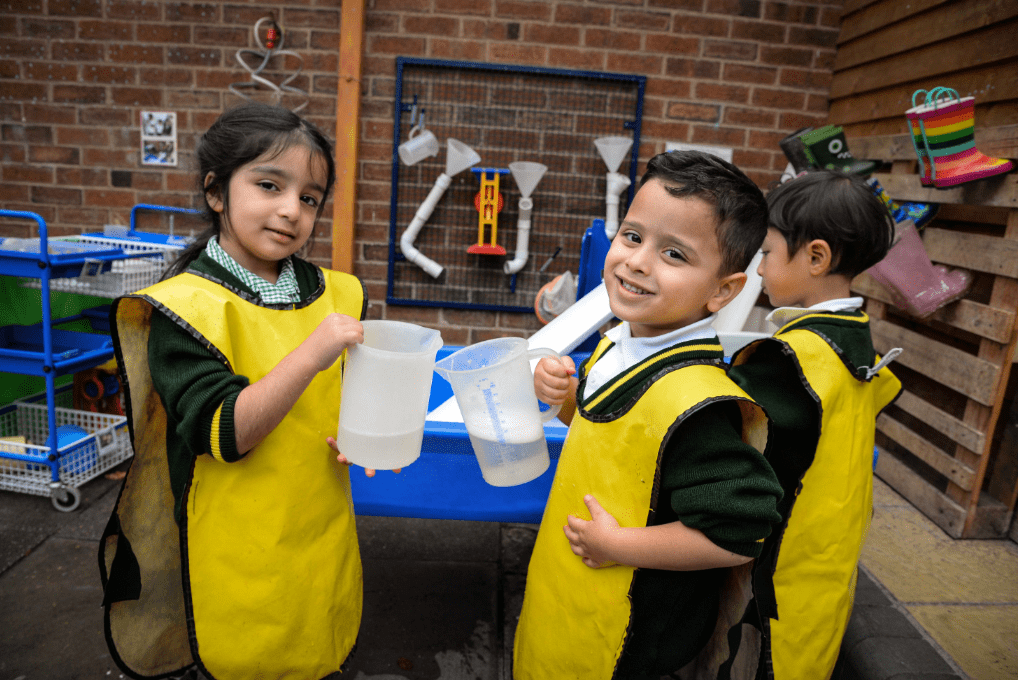
We provide our Nursery and Reception children with a rich, hands-on, play-based curriculum that takes place both indoors and outdoors throughout the day. Our planning is flexible and may be intentional, responsive, or anticipatory, allowing us to adapt to children’s interests, questions, and emerging ideas. We also link learning to meaningful events within the community and the wider world whenever appropriate.
Alongside carefully planned adult-led activities, children are given frequent opportunities to explore, investigate, and lead their own learning. Our staff are highly skilled at observing children’s play, identifying learning opportunities, and knowing when to step in to support or extend their thinking.
All children joining Reception from September take part in the Reception Baseline Assessment. The Department for Education’s parent information document, link below, explains this process in more detail.
At the end of the Reception year, children are assessed using the EYFS Profile. Each of the seven areas of learning is further divided into specific categories to support a clear and accurate picture of each child’s development.
| Communication and Language | Listening, Attention and UnderstandingSpeaking |
| Personal, Social and Emotional | Self RegulationManaging SelfBuilding Relationships |
| Physical Development | Gross MotorFine Motor |
| Literacy | ComprehensionWord ReadingWriting |
| Maths | NumberNumerical Patterns |
| Understanding the World | Past and PresentPeople, Culture and CommunitiesThe Natural World |
| Expressive Arts and Design | Creating with MaterialsBeing Imaginative and Expressive |
Pupils are assessed against the 17 Early Learning Goals, indicating whether they are meeting expected levels of development, or if they are not yet reaching expected levels (“emerging”). The Profile reflects ongoing observations, practitioners’ knowledge and discussions with parents and carers.

|
|
Nursery Curriculum Overview
|
|
|
Reception Curriculum Overview
|
|
|
Information for Parents about the Reception Baseline
|
|
|
EYFS Framework
|

Wilton Drive, Hale Barns
Altrincham, Cheshire WA15 0JF
Call us: 0161 980 4941
Link takes you to our Instagram page ElmridgePrimarySchool

